Home › Fine Motor Activities for 2 Year Olds
Fine Motor Activities for 2 Year Olds
At two, your toddler's hands are learning fast: stacking blocks, turning pages, holding a spoon, and peeling stickers. These 12 fine motor activities for 2 year olds build hand strength, grip, and coordination with things you already have at home — no special toys, no long setup.
Written and maintained by the Toddler Play Lab team.
What can a 2-year-old do with their hands?
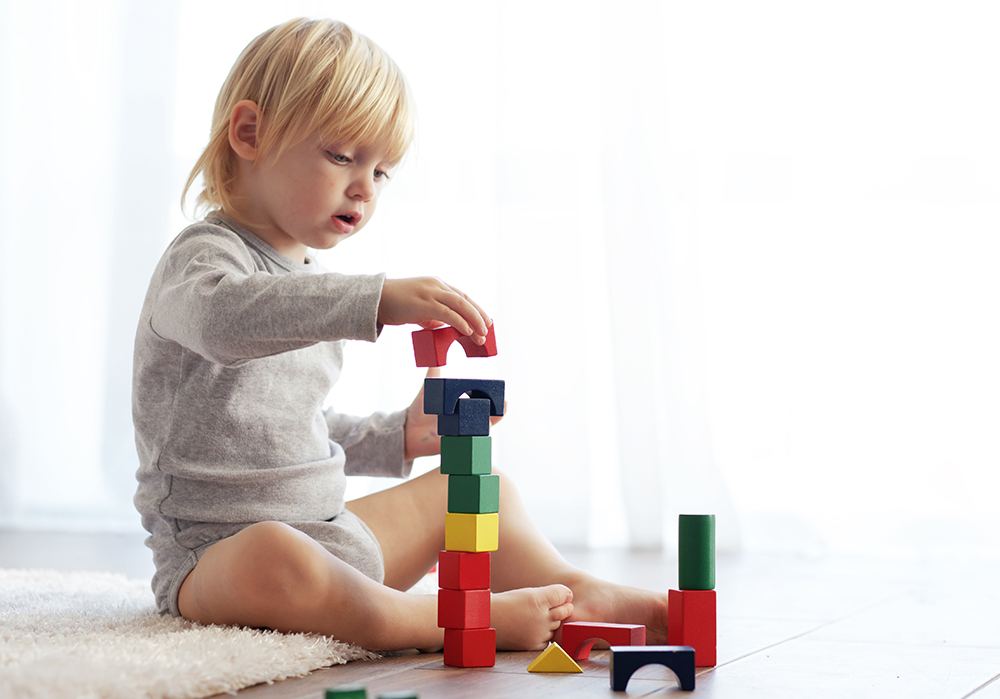
Most 2-year-olds can build a tower of 4 to 6 blocks, turn the pages of a board book one at a time, and feed themselves with a spoon — though spills are still normal. They can hold a cup with one hand, pull off their shoes, and unzip a zipper. Many can turn a doorknob, unscrew a jar lid, and unwrap a snack on their own.
By 24 months, some children start to show a clear preference for one hand. These are the milestones the CDC lists in its Learn the Signs. Act Early. 2-year checklist, and the American Academy of Pediatrics describes the same hand skills on HealthyChildren.org: at age 2, most children handle small objects with ease, and their quiet play is much more focused than it was at 18 months.
That longer focus is the big change. A 2-year-old can sit with playdough or stickers for 5 to 10 minutes — about double what they managed a year ago. Their grip is still a whole-hand fist grip, not the three-finger pencil grip of a 4-year-old. So the goal is not neat writing or careful cutting. It is strength: squeezing, pinching, twisting, pouring, and placing. Every activity below builds one of those moves, and every one fits into a normal day.
12 fine motor activities for 2 year olds
1. Playdough squeeze and roll
You need: playdough (store-bought or homemade), a small rolling pin or a cup. How: show your toddler how to squeeze the dough into a ball, roll it into a snake, and poke it with one finger. Let them pull it apart and squish it back together — the squishing is the workout. Skills: hand strength, finger muscles, creativity. Time: 10–15 minutes.
2. Big beads on a pipe cleaner
You need: large wooden beads with big holes, pipe cleaners. How: bend one end of a pipe cleaner so beads cannot slide off, then let your toddler thread the beads on one at a time. A stiff pipe cleaner is much easier than floppy string at this age. Count the beads as they go. Skills: hand-eye coordination, pincer grip, patience. Time: 10 minutes.
3. Sticker peel and place
You need: big dot stickers, a sheet of paper with a wavy line drawn on it. How: peel the first sticker to get them started, then let your toddler peel and stick the rest along the line. Peeling is the hard part — and the best finger exercise. Skills: pincer grip, precision, focus. Time: 5–10 minutes.
4. Pouring station
You need: two small jugs or cups, water or dry rice, a baking tray underneath. How: fill one jug and let your toddler pour it into the other, then pour it back. Add a funnel for a new challenge. Start with water in the bathtub or outside if spills worry you. Skills: wrist control, pouring, full and empty. Time: 10–15 minutes.
5. Block tower build
You need: wooden blocks, a flat floor. How: stack blocks into a tower together, one at a time, and let your toddler place the top block. Then knock it down — the crash is the reward — and build it again, a little taller. Hand them one block at a time so they practice a careful grip. Skills: balance, hand control, patience. Time: 10 minutes.
6. Pom-pom pickup with tongs
You need: kitchen tongs (or big tweezers), large pom-poms, a muffin tin. How: put the pom-poms in a bowl and let your toddler pick them up with the tongs and drop one into each muffin cup. Use pom-poms at least 1.5 inches across so they are too big to swallow. Skills: grip strength, coordination, color sorting. Time: 10 minutes.
7. Spoon practice at snack time
You need: a child-size spoon, a bowl of cereal, yogurt, or applesauce. How: at snack time, hand your toddler the spoon and let them scoop and eat on their own. Expect spills — put a towel under the bowl and let it happen. Scooping food is real fine motor practice, three times a day. Skills: spoon grip, wrist control, independence. Time: 5 minutes, at meals.
8. Sponge squeeze transfer
You need: two bowls, water, a large sponge. How: fill one bowl with water, put the empty bowl next to it, and show your toddler how to soak the sponge and squeeze the water into the empty bowl. It is messy, simple, and surprisingly hard work for little hands. Skills: hand strength, squeezing, cause and effect. Time: 10 minutes.
9. Chunky puzzles
You need: a wooden puzzle with 4–6 big pieces and knobs to grab. How: take the pieces out and let your toddler fit them back in. Start with the pieces right next to the board, then scatter them a little further away. Name each picture as it goes in: "The cow goes here." Skills: grip, matching, problem-solving. Time: 5–10 minutes.
10. Crayon scribbles and first circles
You need: chunky crayons, big sheets of paper taped to the table. How: let your toddler scribble freely, then draw a big circle yourself and see if they can copy it. Most 2-year-olds cannot draw a circle yet — that usually comes closer to age 3 — so celebrate the scribbles. Big arm movements come before small, careful ones. Skills: grip, arm control, creativity. Time: 5–10 minutes.
11. Big buttons and zippers
You need: an old shirt or jacket with big buttons, or a zip-up bag. How: lay the shirt flat and let your toddler push the big buttons through the holes and pull them back out. Then try a zipper: hold the bottom still while they pull the tab up and down. Start the zipper for them — the pull is the part they can do. Skills: finger strength, dressing skills, independence. Time: 5–10 minutes.
12. Clothespin clip-on game
You need: large clothespins or laundry pegs, a basket or a piece of cardboard. How: show your toddler how to squeeze a peg open and clip it onto the rim of a basket or the edge of a cardboard box. Start with the biggest, easiest pegs you can find. When the rim is full, take them all off and start again. Skills: pinch strength, hand-eye coordination. Time: 5–10 minutes.
What not to expect yet
Two-year-old hands cannot do everything, and that is normal. Do not expect your toddler to cut along a line with scissors, write letters, color inside the lines, button small buttons, or tie shoes. Those skills come at 3 and 4, after the grip and wrist control built by the activities above. If your toddler tries scissors, give them child-safe scissors and let them snip paper freely — cutting a straight line is a year away, and snipping is the right first step.
If they "write" with a crayon, it will be scribbles, and scribbles are exactly right for age 2. Pushing too early only brings frustration for both of you. Let their hands grow strong first; the neat work follows on its own.
Safety first: small parts and supervision
Fine motor play uses small pieces, so stay close. Keep every piece bigger than a toilet paper tube — if it fits through the tube, it can block a small airway. That means large beads, big pom-poms, and chunky puzzle pieces only. Skip small beads, coins, loose buttons, magnets, and batteries entirely at this age.
Homemade playdough is full of salt, so do not let your toddler eat it; store-bought playdough is non-toxic but still not food. Around water, stay within arm's reach, even for a shallow pouring bin. And check every activity for sharp edges before you hand it over: a pipe cleaner end can poke, so bend the tips down. With those few rules, all 12 activities above are safe for a supervised 2-year-old.
Frequently asked questions
How many fine motor activities should a 2-year-old do each day?
There is no quota. One or two short sessions of 5 to 10 minutes is plenty — and everyday moments count too. Scooping cereal with a spoon, turning book pages, and helping unzip a jacket are all fine motor practice. If your toddler plays with their hands for a few minutes a day, they are getting what they need.
My 2-year-old still puts everything in their mouth. Is fine motor play safe?
Yes, with two rules: use only large pieces and stay close. Your toddler cannot swallow anything bigger than a toilet paper tube, so choose large beads, big pom-poms, and chunky puzzle pieces. If your toddler mouths a piece, take it away calmly and offer a bigger one. Most children stop mouthing objects during the second year, but supervision is still the rule at this age.
When should a 2-year-old start using scissors?
Around age 2, with child-safe scissors and an adult right there. Start with free snipping — just cutting into a strip of paper — not cutting along a line. Hold the paper for them at first. Real cutting along lines usually comes closer to age 3, so keep sessions short and stop while it is still fun.
What if my 2-year-old can't stack 4 blocks yet?
Milestones are ranges, not deadlines. Some children stack 4 blocks at 20 months, others at 26 months, and both are fine. Give them plenty of chances to practice with chunky blocks on a flat floor, and try again in a few weeks. If you are worried about your child's development, talk to your pediatrician — they can tell you in minutes what a web page cannot.
Do fine motor activities help with speech?
Hands and words grow together at this age. When you play, talk through what your toddler is doing — "You squeezed the dough! You put the red bead on!" — and you build vocabulary at the same time as hand skills. Reading together helps too: turning pages is fine motor practice, and naming pictures builds words. The activity and the talking work best together.