Home › Sensory Activities for 1 Year Olds
Sensory Activities for 1 Year Olds — 12 Taste-Safe Ideas
At 1, your toddler learns with their whole body — squishing, splashing, shaking, sniffing, and yes, tasting. These 12 sensory activities for 1 year olds are all taste-safe, so when a handful of oats or a smear of yogurt goes in their mouth (and it will), nothing in the tray can hurt them.
Written and maintained by the Toddler Play Lab team.
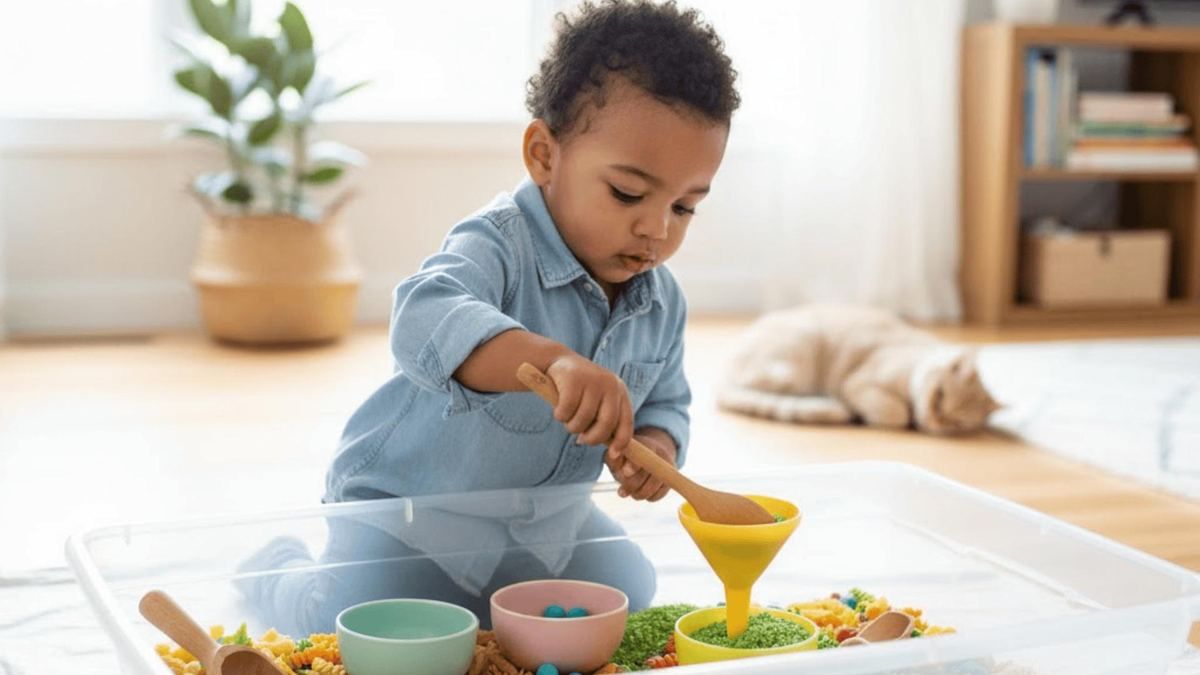
What is sensory play at age 1?
Sensory play is any play that wakes up one or more of the senses: touch, sight, sound, smell, taste, balance, and the body's sense of where it is in space. For a 1-year-old, that is most of play. A baby who squishes cooked pasta is learning soft and sticky. A toddler who pours water from one cup to another is learning full and empty, heavy and light, wet and dry. A child who shakes a bottle and hears it rattle is learning that their hands make things happen.
At this age, the mouth is a sense organ too: babies put things in their mouth to explore, and most 1-year-olds still taste everything they pick up. That is normal, and it is why the materials matter more than the activity — a bin of dry rice looks like a bin of dry oats, but only one is safe when a handful goes in your toddler's mouth.
By 12 months, most children pull up to stand, walk while holding on to furniture, and pick things up between thumb and pointer finger. By 15 months, most take a few steps on their own and feed themselves finger foods. Those CDC milestones are why every setup below uses big pieces, food-based materials, and a tray that keeps the mess in one place.
Sensory play at 1 is not a lesson. There is nothing to teach and nothing to get right. Your job is to set out something safe, sit close, and let your toddler explore. Talk while they play — "soft," "cold," "splash" — and the words stick to the feeling. That is the whole method.
The taste-safe rule: our promise on this page
Every setup on this page follows one rule: if your toddler puts it in their mouth, it must be safe to swallow. That means food, water, and soft fabric — cooked pasta, dry oats, plain yogurt, mashed fruit, warm water, and clean cloth. It means nothing small, hard, or round enough to block an airway, and nothing that swells, breaks into sharp pieces, or contains chemicals.
The rule has two parts. First, the material itself must be edible or harmless: if they eat a spoonful of the yogurt paint or a handful of the oats, the worst outcome is a mess. Second, the pieces must be big and soft: no small beads, no dry beans, no loose rice grains to inhale, nothing that fits through a toilet paper tube. A 1-year-old's airway is small, and anything that fits through a toilet paper tube can block it. Two things do not change with taste-safe materials: you still stay within arm's reach the whole time — taste-safe is not the same as safe to leave alone — and you still check the tray before you start for broken plastic, sharp edges, and small pieces that came loose.
12 taste-safe sensory activities for 1 year olds
1. Cooked pasta squish bin
You need: cooked plain pasta (penne or rotini), a shallow bin or baking tray. How: cook the pasta, let it cool, and put it in the tray with a few big scoops and cups. Let your toddler squish it, pull it apart, and drop it in the cups. Skills: touch, grasp, hand strength. Time: 10–15 minutes.
2. Oatmeal scoop and pour
You need: dry oats, a shallow bin, measuring cups and spoons. How: fill the bin with dry oats and let your toddler scoop and pour, fill cups, and tip them out again. Oats are soft, light, and safe to taste — and they sweep up easily. Skills: pouring, scooping, full and empty. Time: 10–15 minutes.
3. Yogurt finger painting
You need: plain yogurt, a few drops of food coloring, a high chair tray or a baking tray. How: mix a drop of food coloring into small bowls of yogurt and let your toddler smear, swirl, and pat the colors on the tray. It washes off with one wipe. Skills: touch, color, hand movement. Time: 10 minutes.
4. Warm and cool water cups
You need: two cups, warm water and cool water, a towel. How: put warm water in one cup and cool water in the other — both comfortable to touch, never hot — and let your toddler dip one hand in each. Say "warm" and "cool" as they feel the difference. Then give them a sponge to soak and squeeze from one cup to the other. Skills: temperature, squeezing, cause and effect. Time: 10 minutes.
5. Fabric scrap touch box
You need: a box and pieces of clean fabric — fleece, cotton, a silk scarf, a rough washcloth. How: put the fabric pieces in a box and let your toddler pull them out one at a time, feel each one, and stuff it back in. Name the feeling as they touch it: "soft," "smooth," "bumpy." No small pieces, no buttons, no loose threads. Skills: touch, pulling, describing. Time: 5–10 minutes.
6. Muffin tin ball drop
You need: a muffin tin, large soft balls or big pom-poms at least 1.5 inches across. How: set the muffin tin on the floor and let your toddler drop one ball into each cup, then tip the tin over and start again. The balls are too big to swallow. Skills: hand-eye coordination, grasp and release, counting. Time: 10 minutes.
7. Mashed food smear tray
You need: mashed banana, avocado, or sweet potato; a high chair tray. How: spread a spoonful of mashed food on the tray and let your toddler smear it, draw lines in it with a finger, and taste it as they go. This is messy food play, and it is also how a 1-year-old learns textures and practices self-feeding. Skills: taste, touch, self-feeding. Time: 10 minutes.
8. Ice cube slide
You need: two or three large ice cubes, a baking tray, a small cup of warm water. How: put the ice cubes on the tray and let your toddler push them around, watch them slide, and feel how cold they are. Keep the cup of warm water beside the tray so they can warm their hands. Keep it to a few minutes, and take the ice away if their hands get red. Skills: temperature, sliding, watching. Time: 5 minutes.
9. Sealed sensory bottle
You need: a clear plastic bottle with a screw lid, water, a little cooking oil, a drop of food coloring. How: fill the bottle halfway with water, add the oil and coloring, and screw the lid on tight — tape it shut for good measure. Let your toddler shake it, roll it, and watch the colors swirl and separate. Skills: sight, shaking, cause and effect. Time: 5–10 minutes.
10. Citrus and herb smell bowls
You need: orange slices, a sprig of mint, a small bowl of cinnamon sticks (large pieces only). How: put each smell in its own small bowl and hold it near your toddler's nose — "smell the orange!" — then let them touch and taste the orange slice. The mint and cinnamon stay in the bowl for smelling, not eating. Skills: smell, taste, naming. Time: 5 minutes.
11. Bubble watch and pop
You need: a bubble wand and bubble solution. How: blow bubbles slowly and let your toddler watch them float, reach for them, and pop them with one finger. The floating, shining bubbles are a full sensory show: sight, movement, and the little pop. Skills: sight, reaching, tracking. Time: 5–10 minutes.
12. Barefoot texture path
You need: a towel, a foam mat, a piece of grass or a patch of carpet, laid out in a row. How: lay the textures in a short path on the floor and walk your toddler along it barefoot, holding their hands. Let them stop, feel each surface with their feet, and sit down on the one they like best. Skills: balance, touch, walking. Time: 5–10 minutes.
Sensory play by sense at age 1
Touch. This is the biggest sense at 1. Cooked pasta, oats, yogurt, water, and fabric give your toddler soft, sticky, wet, smooth, and bumpy to compare. Offer one texture at a time, and let them touch it with hands first, then feet.
Sight. A 1-year-old loves bright color and movement: the swirl in a sealed bottle, bubbles floating, yogurt paint in two colors. Keep it simple — one or two colors at a time is plenty.
Sound. Shaking, banging, and splashing are how a 1-year-old makes sound. A sealed bottle with water, a metal bowl to tap with a spoon, and splashing in a water bin all teach the same lesson: I do something, and a sound comes back. Keep sounds gentle — no loud toys right by their ears.
Smell and taste. At 1, smell and taste go together, and both are food-first: orange, mint, cinnamon, banana, yogurt. Skip scented candles, essential oils, and anything you would not put in food. If you would not eat it, do not put it in a 1-year-old's sensory tray.
Movement and balance. The two senses parents forget are balance and the body's sense of where it is. Crawling through a tunnel, walking a texture path barefoot, and being gently rocked or bounced all feed those senses. They are also why sensory play and movement play overlap so much at this age — see our sensory play activities for toddlers for the full guide.
What to avoid at age 1
Dry rice and dry beans. They look harmless in a sensory bin, but they are small, hard, and easy to inhale or choke on, and a 1-year-old will put a handful in their mouth. Save dry rice and beans for age 3 and up, with supervision. At 1, use cooked pasta or dry oats instead — same scooping and pouring, none of the risk.
Small beads and small pom-poms. Anything small enough to fit through a toilet paper tube can block a small airway. That means small beads, small buttons, coins, marbles, and pom-poms under 1.5 inches across. Use large soft balls and big pom-poms only, and check every piece before you start.
Water beads. Do not use them at all. Water beads look like candy, and a child who swallows one can be seriously hurt: the beads absorb fluid and keep growing inside the body, causing blockages. The American Academy of Pediatrics says they are a choking hazard, especially in children younger than 3, and that it is safest not to have water beads in a home with young children. The AAP supports banning water beads marketed for children's use. There were over 8,000 U.S. emergency department visits related to water beads between 2007 and 2022, and at least one child died. If you think your child swallowed a water bead, seek treatment right away.
Balloons, magnets, and button batteries. Uninflated balloons and broken balloon pieces are a choking hazard. Small high-powered magnets and button batteries are not sensory toys at all — if swallowed, they can cause serious internal injury. Keep them out of the play area entirely, and check the floor for them before you set up.
Water without supervision. Even a shallow bin of water needs you within arm's reach, the whole time. Never leave a 1-year-old alone with water, even for a moment, and keep the water shallow — a few inches at most. For more water ideas with the same safety rules, see our water play activities.
Frequently asked questions
Is sensory play safe for a 1-year-old who puts everything in their mouth?
Yes, if everything in the tray is taste-safe and you stay close. Use food and water only — cooked pasta, dry oats, yogurt, mashed fruit, warm water — and keep every piece big and soft, nothing that fits through a toilet paper tube. A 1-year-old who mouths everything is normal; choose materials that are safe to mouth, and keep playing.
How long should a sensory activity last at age 1?
A few minutes is plenty. Most 1-year-olds play with a sensory setup for 5 to 10 minutes before they lose interest, and that is a full session. When they turn away or start throwing the tray, the activity is over. Short and happy beats long and fussy — you can set the same tray out again tomorrow.
Can I use dry rice or beans in a sensory bin for a 1-year-old?
No. Dry rice and dry beans are small, hard, and easy to choke on or inhale, and a 1-year-old will put them in their mouth. Save them for age 3 and up, with supervision. At 1, use cooked pasta or dry oats instead — your toddler gets the same scooping, pouring, and digging, with materials that are safe to taste.
What if my 1-year-old will not touch messy textures?
That is normal, and it is not a problem to fix. Some 1-year-olds dive into yogurt with both hands; others touch it once and pull back. Offer a spoon or a cup so they can play without touching it directly, and let them watch you touch it first. Try again another day. Never force their hands into a texture — a child who is allowed to watch first usually joins in on their own.
Do I need special sensory toys for a 1-year-old?
No. Everything on this page uses things from your kitchen: pasta, oats, yogurt, water, fabric, a muffin tin, and a few cups. A 1-year-old does not need a special toy to learn from a texture — a bowl of cooked pasta teaches more than most products on a shelf. Save your money and your shelf space; the kitchen is the sensory toy box.
Sources
- American Academy of Pediatrics, HealthyChildren.org — Water Beads: Harmful if Swallowed, Put in Ears: healthychildren.org/English/safety-prevention/at-home/Pages/Water-Beads-Harmful.aspx
- Centers for Disease Control and Prevention, Learn the Signs. Act Early. — 2 Year Online Milestone Checklist: cdc.gov/act-early/digital-online-checklist/2-years.html
- Centers for Disease Control and Prevention, Learn the Signs. Act Early. — milestone checklists for ages 1 year and 15 months. The 1-year and 15-month movement and exploration milestones in this guide come from those CDC checklists, which follow the same Learn the Signs. Act Early. series as the linked 2-year checklist.